A price war without quality transparency: what the AVD market publishes, and what it does not
97 announced Altersvorsorgedepots, 24 with a price, none with a key information document. The market is becoming fee-transparent before it becomes quality-transparent, and advice becomes the bottleneck.

The Altersvorsorgedepot market has started its price competition before it has a measure of quality: of 97 announced products, 24 state an ongoing cost rate, none a key information document, none a complete cost overview (as at 7 October 2026). The market is becoming fee-transparent, not quality-transparent, and what an account actually delivers over thirty years, lifecycle control, payout phase, advice, documentation, appears in almost no announcement.
What the market has published so far
We record every public Altersvorsorgedepot announcement in a product database of our own, provider by provider, attribute by attribute, with source and date. By our counting rule, 50 providers with a public offer statement were in the market on 7 October 2026, with 97 announced products between them. 24 of those products state at least one ongoing cost figure. Not one has a key information document, not one a complete cost overview of fund, transaction and contract costs, none is certified by the Federal Central Tax Office, and none can be taken out today.
- 50 providers with a public offer statement, 97 announced products.
- 24 products with at least one published ongoing cost figure.
- 0 key information documents, 0 complete cost overviews.
- 0 certifications by the Federal Central Tax Office, 0 products available today.
That is not a criticism, it is the calendar. As at 11 September 2026 the certification body had issued no certificate for an Altersvorsorgedepot, and the independent provider monitor counted 59 of 76 observed institutions as “confirmed” on 7 October, 15 as “in preparation” and none as certified. The market is announcing; it is not yet delivering. What it announces is revealing nonetheless, because it shows what the industry wants to talk about first: names and prices. The full list sits in our AVD product database; the figures there are in the open, the records on access.
The price war
The legislator set the price anchor: the Standarddepot carries an effective cost cap of one per cent a year (§ 1(1c) AltZertG). The market undercut it by a wide margin within weeks. On 28 September 2026 Deutsche Bank, together with Postbank, presented a digital DWS Standarddepot at 0.28% a year: 0.10% fund costs plus a 0.18% contract fee, with the contract fee waived for the first two years, so that 0.10% applies at first. Transaction costs come on top and are not quantified. An advice-based variant is to follow later at 0.99% a year.
The Börsen-Zeitung commented the same day that Deutsche Bank was thereby “steamrolling” its own fund subsidiary: for its directly distributed ETF account, DWS states effective costs of 0.42% without and 0.44% with transaction costs (provider figures of 30 September 2026). Fidelity lowered its prices on its product pages as at October 2026: the VorsorgeDepot Plus costs around 0.6% a year plus €2 a month instead of the previous 1.35%, the VorsorgeDepot around 0.35% plus €1 a month. Within ten days the price range of digital Standarddepots has thus settled between 0.28% and 0.44%, before a single product is certified.
What the figures say, and what they do not
Three things are worth reading before comparing the figures. First: fund costs and contract costs are two separate items. 0.28% is made up of 0.10% for the ETFs and 0.18% for the contract; anyone quoting only the first is comparing funds with products. Second: a two-year waiver is an introductory price, not a price. For a product meant to run for thirty years, the rate from year three is what counts. Third: transaction costs are missing from almost every figure, and they are why the same provider is quoted at 0.42% and at 0.44%. Both are correct, depending on whether they are included.
In this market, price has become a necessary condition. It is not a sufficient one.
The industry itself seems to know this. In the AVD-Barometer 2027 by dwpbank and lemon.markets, a survey of 88 institutions in summer 2026, 7% name price leadership as the strategy for their individual Altersvorsorgedepot, 40% want to stay at the level of their current account offer, 51% have not yet decided. Only 9% consider low costs the most important success factor; 29% name simplicity, 24% the subsidy, 18% qualified advice. On the Standarddepot, 19% consider the product viable under the cost cap, 28% difficult to not viable, 52% cannot judge yet. 77% intend to offer it regardless.
What is missing: quality transparency
An Altersvorsorgedepot is not a savings plan with an allowance attached. It is paid into for thirty to forty years, carried over into a payout phase that runs to at least 85, and advised on at a minimum of two points: at the outset and at the transition into retirement, and for existing customers additionally when it is compared with their Riester contract. What quality a product has at those points appears in none of the price figures, and so far in hardly any announcement.
- Lifecycle control: how is risk reduced over the term, per customer or per cohort, and who decides? Where an announcement says anything about it, it is one sentence, a ten-year glide path for instance. Several announced Standarddepots consist of two prescribed funds whose weighting the saver sets personally.
- Payout phase: a payout plan, an annuity, a partial lump sum, and at what cost? The act allows up to 30% as a lump sum and a payout plan to at least 85; what a provider makes of that is a footnote in the announcements.
- Advice: who advises, in which channel, with what documentation, and how is the Riester book compared? The price figures distinguish between digital and advised, but do not say what the advice delivers.
- Documentation: zero key information documents, zero complete cost overviews. Only with certification will the documents arrive from which quality can actually be read.
An uncomfortable sequence follows. The prices are here, the certificates and documents are coming, and many switching decisions in the Riester book will be taken before the quality differences between premium offers are visible. The market becomes fee-transparent, not quality-transparent. Anyone looking only at price in this phase is optimising the one variable that is fully published and ignoring the ones that decide the outcome.
Why advice becomes the bottleneck
The second gap is not a product gap but a capacity gap. In “Europe's Retirement Savings Gap” of 2 September 2026, a survey of around 6,000 people in Germany, France, Italy and Spain, BCG puts the replacement rate of the state pension in the EU at 45% in 2022 and 41% in 2045. Only 18% of European consumers own a private pension product, an EIOPA figure that BCG cites. At the same time, more than 90% of respondents welcome being approached by an adviser at key life moments, and around two thirds inform themselves online or with AI tools first.
For Germany, the existing book comes on top. In a representative survey by Allianz Lebensversicherung from April 2026 (n > 1,500), 75% of Riester customers want advice from their provider or intermediary, and 58% of respondents want a personal conversation, on site or by video, if a switch is on the table. The figures come from a provider press release and argue for the advice channel; the subgroup size is not disclosed. The direction is clear nonetheless: the Riester book does not want to switch first, it wants to be advised first.
The provider side expects the same. In the AVD-Barometer 2027, 81% of the institutions surveyed expect a high or very high need for advice, 82% plan advice in the branch, 58% digital self-service alongside it, 47% hybrid journeys, and not a single institution is counting on automated recommendations. As the biggest operational hurdle, 70% name adviser training and 62% the time to launch; technical integration follows only afterwards at 33%. 84% are evaluating or planning the Riester transfer as a service, but only 30% have it firmly in their offer.
The bottleneck of 2027 is neither the technology nor the price. It is the advice hour.
Add it up and you get a market in which the advice hour is scarcer than the product: demand for advice is high, the existing book is large, the adviser population is the same as today, and the industry intends to answer with branches and training. Anyone who runs advice purely as a cost centre will ration it. Anyone who builds it as a process can scale it.
Xaver's position
We build the Altersvorsorgedepot as a white-label product for partners, and we have decided to answer the quality questions before the market asks them. Four answers, stated this way on xaver.com:
- 01
Lifecycling per customer, not per cohort
Risk control follows the individual contract, its horizon and its payout phase, not a cohort fund. Three glide paths for AVD Premium, eleven allocation steps for AVD Standard, and a payout phase that knows payout plans and reinvestment.
- 02
Advice at scale: fixed rules for the recommendation, AI for the conversation
The AI adviser guides customers through the whole journey, explains every step and helps them decide. Our AI conversation layer (AIC) leads the conversation and makes sure the language model never makes a recommendation itself: product and portfolio recommendations are calculated by fixed rules from the MiFID II suitability assessment, so every recommendation is traceable and auditable. The documentation is produced in the process, not afterwards. The Riester book is evaluated automatically: four options compared, the recommendation documented.
- 03
Open architecture
Funds and building blocks without being tied to one provider, fund costs from 0.05% TER, premium building blocks 0.09–0.11%. The rest of the cost budget remains available for asset management, advice and distribution, and it is disclosed.
- 04
A start in two stages
Pre-registration from October 2026: advice, suitability assessment, product choice; confirmation with one click from 1 January 2027. Subsidised Frühstart-Rente: starting January 2027, we are ready. Partners starting this way are Helvetia and BCA with the “BCA Xaver Altersvorsorgedepot powered by ODDO BHF Asset Management”.
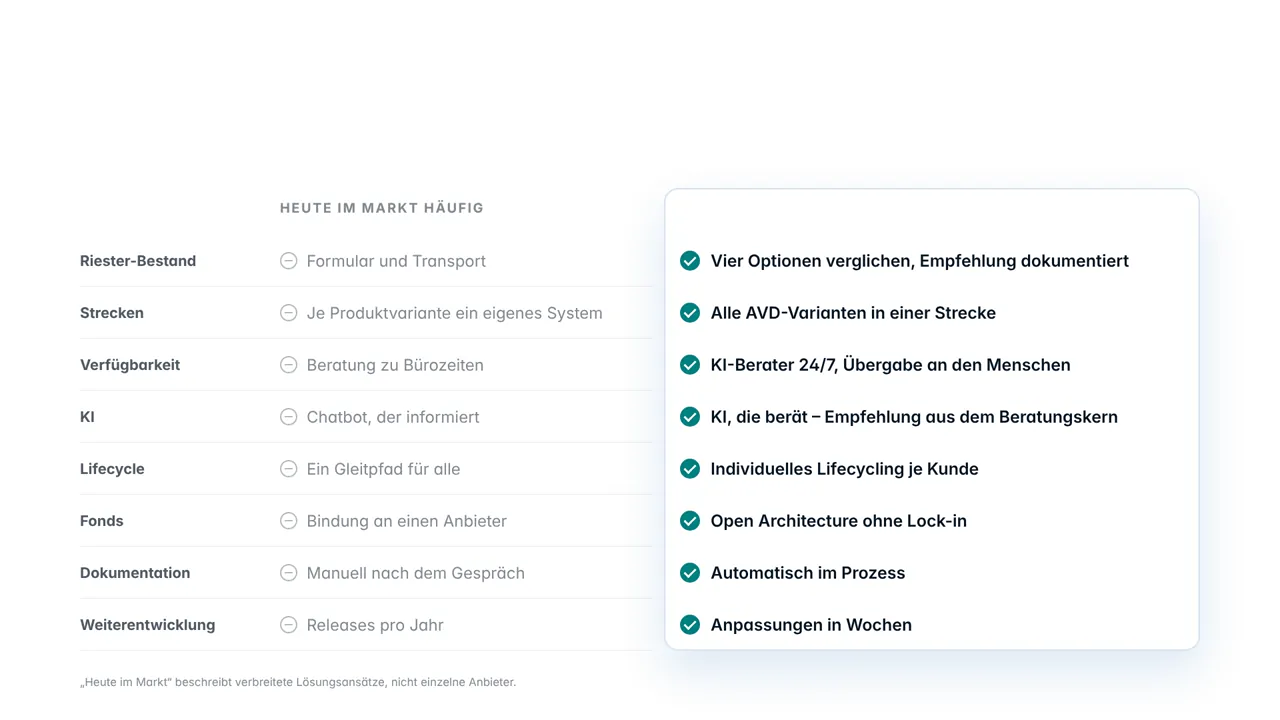
That is a position, not a verdict. The prices the market has published are facts, and 0.28% is a price to be taken seriously for a digital Standarddepot. Our argument is the gap beside it: anyone offering an account meant to last thirty years has to answer the quality questions as publicly as the price question. We do, and we will be measured against it as soon as the market's documents are available.
Frequently asked
Is cheaper automatically better?
No. Price is the only variable the market has fully published so far, which is why it looks like the only criterion. The outcome after thirty years is also decided by the investment and how it is steered over the term, by the payout phase, by the advice at the outset and at the transition into retirement, and by the documentation. Two prices are, moreover, only comparable if they contain the same things: fund costs, contract costs and transaction costs, over the full term rather than two introductory years.
What is the difference between the Standarddepot and AVD Premium?
The Standarddepot is the statutory standard variant with an effective cost cap of one per cent a year (§ 1(1c) AltZertG) and a simple, standardised investment; several announced Standarddepots consist of two prescribed funds. At Xaver, AVD Premium is the individually managed line: lifecycling per customer with three calibrated glide paths, an open fund architecture and greater depth of advice, completed in the same journey as AVD Standard. Only the Standarddepot is subject to the cost cap; for freely distributed variants, the complete cost overview is therefore the yardstick.
Where do I find the full list?
In the AVD product database on xaver.com under Insights. The figures and key insights are in the open; the records with every attribute, source and date sit behind an access code. Partners receive it as part of our work together, interested parties can request it.
Sources
- 01Xaver AVD product database, own survey of public provider statements, as at 7 October 2026 (50 providers, 97 products, 24 with conditions, 0 KIDs, 0 complete cost overviews, 0 certified, 0 available)xaver.com/insights/avd-produktdatenbank
- 02Deutsche Bank AG, press release “Deutsche Bank startet mit breitem Vorsorgeangebot zum Altersvorsorgedepot”, 28 September 2026 (DWS Standarddepot 0.28% p.a., contract fee waived in years 1–2; advised account 0.99% p.a.)db.com/news, retrieved 7 October 2026
- 03Börsen-Zeitung, “Deutsche Bank überrollt DWS”, 28 September 2026 (price gap 0.28% vs 0.44%)boersen-zeitung.de/meinung-analyse/deutsche-bank-ueberrollt-dws
- 04Altersvorsorgedepot provider monitor, as at 7 October 2026 (59 of 76 institutions confirmed, 15 in preparation, 0 certified; DWS effective costs 0.42%/0.44% per provider figures of 30 September 2026), licence CC BY 4.0altersvorsorgedepot-anbieter-vergleich.de/anbieter-monitor
- 05Fidelity International, product pages VorsorgeDepot (around 0.35% p.a. + €1 a month) and VorsorgeDepot Plus (around 0.6% p.a. + €2 a month, previously 1.35%), as at October 2026fidelity.de/produkte-services/anlageloesungen, retrieved 7 October 2026
- 06Federal Central Tax Office, list of all certificates issued under the AltZertG, as at 11 September 2026 (no certificate for an Altersvorsorgedepot)bzst.de, certification body
- 07§ 1(1c) AltZertG, effective cost cap on the Standarddepot; pension reform act, Federal Law Gazette I 2026 No. 156
- 08BCG, “Europe's Retirement Savings Gap”, 2 September 2026, survey n ≈ 6,000 in DE/FR/IT/ES (replacement rate 45% 2022 → 41% 2045; > 90% welcome contact at life moments; ~ two thirds research online/AI first); 18% ownership of private pension products = EIOPA figure cited by BCGbcg.com/publications/2026/europes-retirement-savings-gap
- 09Allianz Lebensversicherungs-AG, press release 21 July 2026, representative survey April 2026, n > 1,500 (75%: Riester customers who want advice from their provider or intermediary; 58%: respondents who want a personal conversation if a switch is on the table; subgroup n not disclosed)allianz.de/presse/mitteilungen
- 10dwpbank and lemon.markets, “AVD-Barometer 2027”, industry survey 9 July to 7 August 2026, n = 88 institutions, not representative according to the authors, published October 2026dwpbank.de
- 11Helvetia, media release 7 October 2026; BCA AG, press release 1 October 2026 (“BCA Xaver Altersvorsorgedepot powered by ODDO BHF Asset Management”)helvetia.de/de/presse · cash-online.de, 1 October 2026
- 12Xaver product documentation, 2026: lifecycling per customer, rule-based recommendation, open architecture, fund costs from 0.05% TER, premium building blocks 0.09–0.11%, start in two stagesxaver.com/produkte/altersvorsorgedepot
This piece explains the legal position and replaces neither legal nor investment advice. What governs are the statutes as they stand and the terms of the specific contract.
Read next
All insights →
Walk through your use case with us.

- We show you the modules that matter for your case
- With Max Bachem, founder & CEO
- No obligation, no preparation needed