Agentic commerce in retirement provision: when AI assistants advise
AI assistants will find, compare and initiate financial products. In subsidised pensions, what counts then is what is documented, and who says who they are.

Agentic commerce describes channels in which AI assistants pick up offerings, compare them and initiate them on a user's behalf. In subsidised retirement provision that is not a solved problem: advice here carries documentation duties, and responsibility for it cannot be delegated to a model. Xaver prepares its offerings for this channel through open and controlled interfaces; we do not claim that business is being completed through it today.
What the term means, and what it does not
The term is currently used for two very different things. One is an assistant that answers questions on a website or in an app and guides a person through a journey: a conversational interface, operated by the provider itself. The other is an assistant that does not belong to the provider; it belongs to the customer, finds offerings in the market, compares them and initiates a process.
Only the second case is agentic commerce in the narrower sense, and only that one changes the logic of distribution. When an external assistant compares products, what becomes visible is what is documented in machine-readable form, terms, costs, eligibility for subsidy, target market. Anything that exists only in a PDF for a human to interpret simply does not appear in that comparison.
Four phases, one layer
In practice the AI layer is not an additional channel alongside the existing ones but a layer across all of them. It works in the same four phases that structure distribution and operations, and its role differs in each.
- 01
Discover
Answering questions before anyone opens a form: what the Altersvorsorgedepot is, what someone is entitled to, how it differs from an existing contract. Around the clock and in the language the question is asked in, at Xaver, in more than 50 languages.
- 02
Advise
Guiding and explaining: answering questions about the customer's own case and explaining the product and portfolio recommendation. The recommendation is calculated by fixed rules, not by the language model. Suitability assessment and advice documentation run inside the journey.
- 03
Complete
Supporting completion: queries about entries, explaining the documents, pointing out what is still missing. Completion itself stays inside the journey built for it; the AI explains it, it does not replace it.
- 04
Service
Servicing after completion: status questions, contribution changes, allowance matters, documents. That is the part that runs for decades, and where servicing costs otherwise grow along with the book.
The disclosure principle
Anyone talking to an AI has to know it, in chat and on the phone alike, without having to ask. At Xaver the AI adviser identifies itself as AI and points out the route to personal advice. That is a principle, not a setting a partner can configure.
The AI identifies itself as AI. That is a principle, not a setting.
The second part of the principle is the handover. A personal adviser can be brought in at any time, at the customer's request or when the case suggests it, the need for a guarantee, capacity to bear losses, what to do with an old contract, and without loss of context: the same data, the same state, no starting over. A handover that makes the customer repeat her answers is not a handover.
Why the recommendation does not come from the language model
In investment advice, the suitability assessment is not a formality: knowledge and experience, financial circumstances, investment objectives and risk tolerance have to be collected, assessed and documented (§ 64 WpHG). Even the order is not arbitrary, under ESMA's guidelines, sustainability preferences may only be collected after knowledge, financial circumstances and objectives have been established. A conversation flow that reorders this because it feels smoother is not merely inelegant; it is open to challenge.
Responsibility for a recommendation cannot be delegated to a model whose answer cannot be traced. That produces a clear division of labour. Our AI conversation layer (AIC) leads the conversation and makes sure the language model never makes a recommendation itself: product and portfolio recommendations are calculated by fixed rules from the MiFID II suitability assessment, so every recommendation is traceable and auditable. That is why the AI adviser can give personal advice without responsibility travelling with the interface: it stays with the regulated firm, and suitability assessment and advice documentation run inside the journey.
What that means for interfaces
Anyone who wants to be visible to external assistants has to describe their offering in machine-readable form: product data, cost structure, subsidy logic, target market, availability. That is a data task more than an AI task, and it is hard for firms whose product truth is spread across several systems and an archive of PDFs.
- One version of the data across every channel. A case that starts in an assistant and continues with an adviser only works if both work on the same data.
- Controlled interfaces. Open does not mean unprotected: who may retrieve what is part of the design, not a filter added afterwards.
- A continuous evidence trail. Every recommendation needs a traceable history, regardless of the channel it arose in.
- The same language for humans and machines. What an assistant reads out should be identical to what the key information document says.
What it looks like: a demo, not a channel
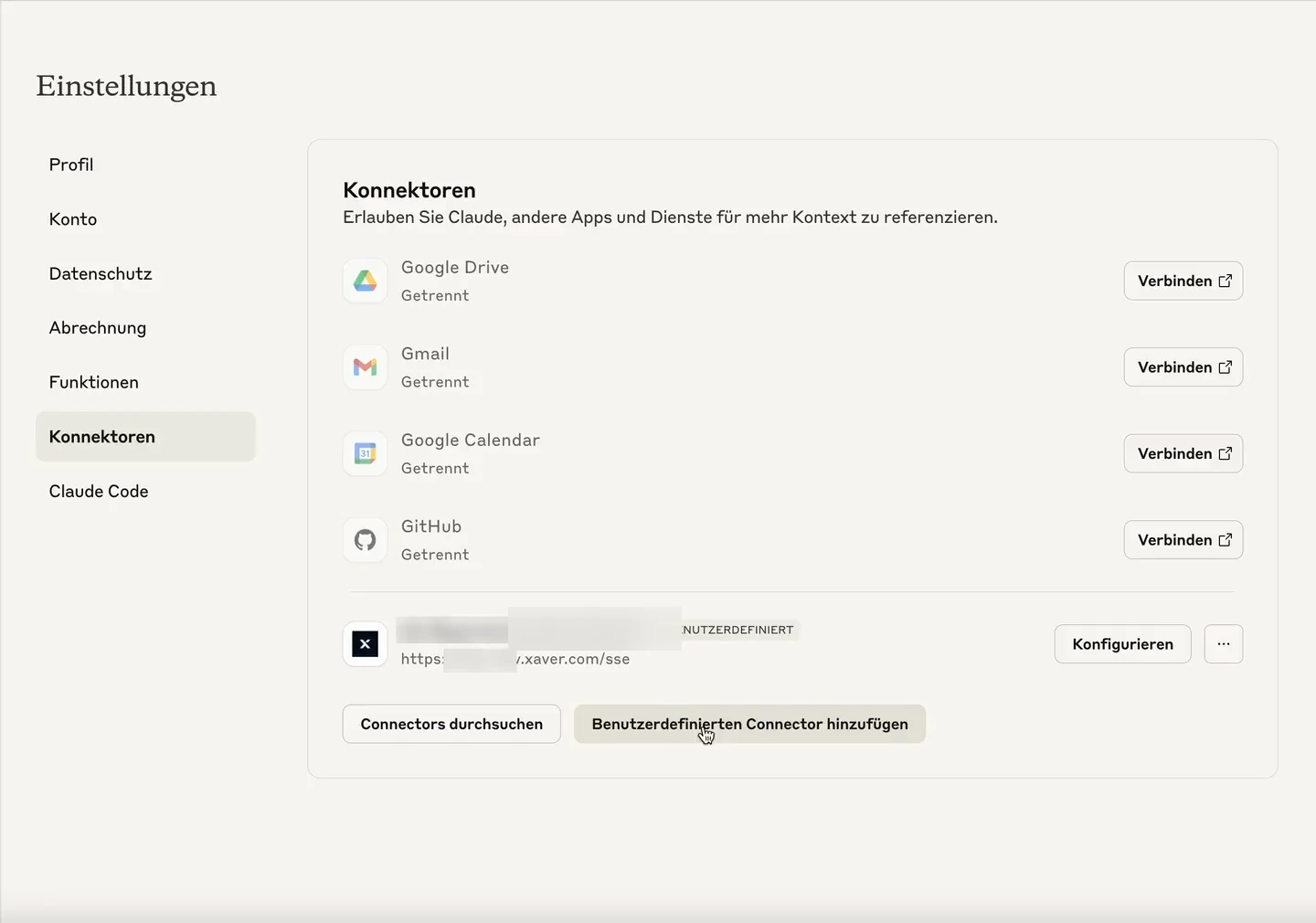
The recording shows an external AI assistant reaching a prepared Xaver environment through a controlled interface (MCP): it reads product data, checks the subsidy for an example customer, prepares the comparison and hands over to the journey that carries the documentation duties, instead of completing anything itself. Brand and data are examples; the channel is prepared, not live.
Where the channel stands today
Soberly assessed, agentic commerce in subsidised provision is preparation today, not distribution. The assistants exist, the interfaces are being built, the supervisory classification is in motion. What is being decided now are the preconditions: whether product data exists in machine-readable form, whether channels share the same state, whether disclosure and handover are set as principles or offered as options.
Firms that create those preconditions now will later have an integration task. Firms that create them later will then have a data project, and a data project takes longer than launching a channel.
Frequently asked
Does the AI adviser give personal recommendations?
It explains them. The personal recommendation is calculated by fixed rules from the MiFID II suitability assessment; the AI adviser explains it and answers questions. A personal adviser can be brought in at any time, working from the same data. The AI adviser always identifies itself as AI.
How does a customer know they are talking to an AI?
Because it says so, in writing and out loud. The AI adviser identifies itself as AI, in chat and in a voice conversation alike, and points out the route to personal advice. That is a principle, not a setting that can be switched off.
What does agentic commerce mean at Xaver in concrete terms?
That the platform makes its offerings available, through open and controlled interfaces, in a form external AI assistants could pick up and pass on. Xaver is preparing that channel. We do not claim that business is being completed through it today.
Can advisers use the AI layer too?
Yes, and day to day that is the part that carries most weight. Advisers use the same layer for preparation, for looking things up in product and subsidy rules, and for documentation. It is the same data the customer sees, which is what makes a lossless handover between the two sides possible at all.
Sources
- 01§ 64 WpHG, suitability assessment and suitability statement in investment advice
- 02ESMA guidelines on the MiFID II suitability requirements, the order of collection, including sustainability preferences
- 03The EU's regulation on artificial intelligence, classification per use case, treated here explicitly as an open point
- 04Xaver platform documentation, 2026, AI layer, journey phases, language coverage
This piece explains the legal position and replaces neither legal nor investment advice. What governs are the statutes as they stand and the terms of the specific contract.
Read next
All insights →
Walk through your use case with us.

- We show you the modules that matter for your case
- With Max Bachem, founder & CEO
- No obligation, no preparation needed