Every contract is assessed on its own.
Cost, guarantees, allowance history and remaining term are captured and assessed, instead of one blanket recommendation for the whole book.
Without a check per contract, all a Riester book allows is a blanket recommendation, neither right for the customer nor defensible towards the supervisor. The service assesses every contract individually, compares it with the Altersvorsorgedepot and documents the outcome, including where it is to hold.
A campaign across a Riester book fails on the case-by-case assessment. As long as nobody can weigh cost, guarantee and remaining term per contract, all that is left is a blanket recommendation, which is neither right for the customer nor defensible towards the supervisor.
The book evaluation reads out cost, guarantees, allowance history and remaining term, sets the contract against the Altersvorsorgedepot in a structured way and documents both outcomes, switching and holding alike. Where the decision is to switch, the transfer continues digitally, with a visible status.
The Riester comparison in the demo portal runs through to the rated recommendation across all four options. The process is designed for tens of thousands of advice sessions and transfers a month, a statement about the capacity of the process, not about today's volumes.
Try the Riester comparisonCost, guarantees, allowance history and remaining term are captured and assessed, instead of one blanket recommendation for the whole book.
Switch or hold: both outcomes are reasoned and documented, and traceable in the advice record.
Where the decision is to switch, the transfer runs with no manual intermediate steps on our side, visible to customer and adviser in the portal.
The process is designed for tens of thousands of advice sessions and transfers a month, a statement about the capacity of the process, not about today's volumes.
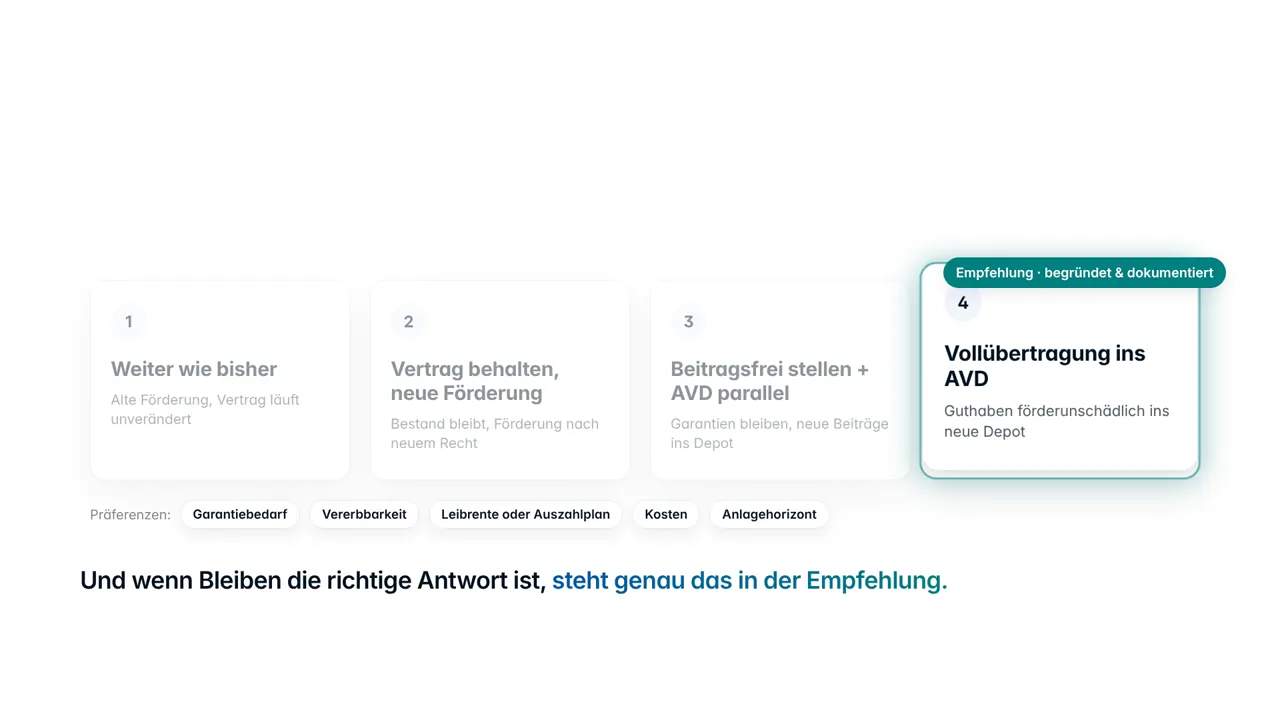
Old subsidy, the contract runs on unchanged.
The balance stays, the subsidy follows the new rules.
Guarantees stay, new contributions go into the account.
The balance moves into the new account without losing the subsidy.
Every Riester contract is assessed individually, compared with the Altersvorsorgedepot in a structured way and documented, including where the recommendation is to hold.
Source of the two rates: Allianz Lebensversicherungs-AG, press release of 21 July 2026, representative survey April 2026, n > 1,500 (75%: Riester customers who want advice from their provider or intermediary; 58%: respondents who want a personal conversation on site or by video if a switch is on the table). Minutes per conversation, the share of digitally prepared conversations and 1,000 productive advice hours per adviser-year are assumptions, not measurements. No statement about any individual partner's results.
When switching provider on a Riester contract, the transfer costs are capped by law at €150: on the ceding side for contracts running less than five years, and on the receiving side as a one-off flat charge. The analysis reads these items out of the documents and shows them openly in the comparison. What always governs is the wording of your specific contract.
On our side the transfer runs with no manual intermediate steps. The overall duration depends on the ceding provider, which has to terminate the contract, settle it and transfer the capital, the part we cannot speed up. Rather than quoting a blanket deadline, we show the status of every case in the portal.
A Riester contract usually contains a contribution guarantee; it is paid for through the investment and limits its return potential. The Altersvorsorgedepot is constructed differently. Whether giving up a guarantee makes sense in a specific case depends above all on remaining term and risk capacity, and that is exactly the question the analysis answers, rather than stepping around it.