No overnight batch that everything is timed around.
The backend was built in 2025/26: no overnight batch windows, no mainframe-bound interfaces and no processes that are manual out of habit.
Systems grown over decades time their operations around overnight batches and clear exceptions by hand, and that eats the margin of a contract worth €100 a month. Here allowance operations, rebalancing and lifecycle control run automatically, on an API-first backend with no legacy.
Systems grown over decades time their operations around overnight batches and clear exceptions by hand. In subsidised provision that is exactly what eats the margin of a contract worth €100 a month, and it gets expensive faster as the book grows, not cheaper.
Allowance operations, rebalancing and lifecycle control run automatically on a backend built in 2025/26, API-first: no overnight batch windows, no mainframe-bound interfaces, and no processes that are manual out of habit.
Portfolios from 0.05% TER, complete AVD portfolios from 0.09% TER including active ETFs. (Source: Xaver product conditions, 2026.) Structure, ways to connect and the authentication concept are in the documentation.
API documentationThe backend was built in 2025/26: no overnight batch windows, no mainframe-bound interfaces and no processes that are manual out of habit.
Allowance operations, rebalancing and lifecycle control, the processes that otherwise get expensive fastest as a book grows.
Complete AVD portfolios from 0.09% TER including active ETFs; platform and distribution terms are separate. (Source: Xaver product conditions, 2026)
Built API-first, not fitted with an API afterwards; structure, ways to connect and the authentication concept are in the documentation.
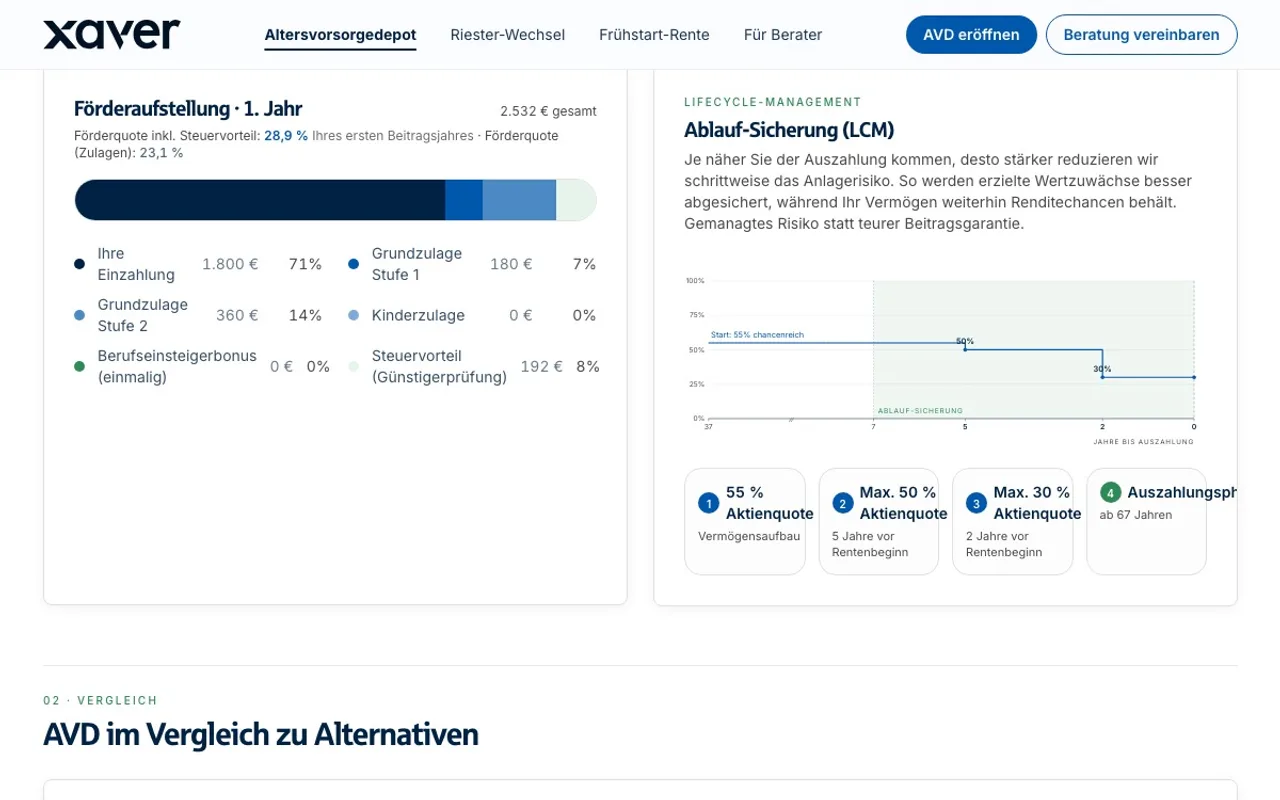
Investment concept, cost model, target-market definition and the lifecycle glidepath sit in the backend as a rule set, per product and per partner.
The individual account's target allocation is derived from those rules, not from a distribution agreement in the background.
A contribution, an allowance, a drift from the target quota or a step change in the glidepath triggers the run. It runs automatically, not as an overnight job everything else has to be timed around.
The result and status of every run are available through the same open interfaces everything else is connected by.
A schematic of the processing chain, drawn from the module description and the API documentation. A recording of the investment backend will replace it as soon as one exists.
An API-first investment backend with no legacy: allowance operations, rebalancing and lifecycle control run automatically. Portfolios from 0.05% TER, complete AVD portfolios from 0.09%.
To the TER, that is the ongoing cost of the investment building blocks in the portfolio: portfolios from 0.05% TER in the AVD standard, complete AVD portfolios from 0.09% including active ETFs. Platform and distribution terms are separate from that and depend on the cut of the partnership. (Source: Xaver product conditions, 2026)
Yes. If you run distribution and portals yourself and need only the investment backend, that is a regular cut. The reverse works just as well: if you have a backend of your own, the other modules build on it.
Through open interfaces, the architecture is built API-first, not fitted with an API afterwards. Structure, ways to connect and the authentication concept are described in the documentation; we provide the full reference as part of demo or integration access.